
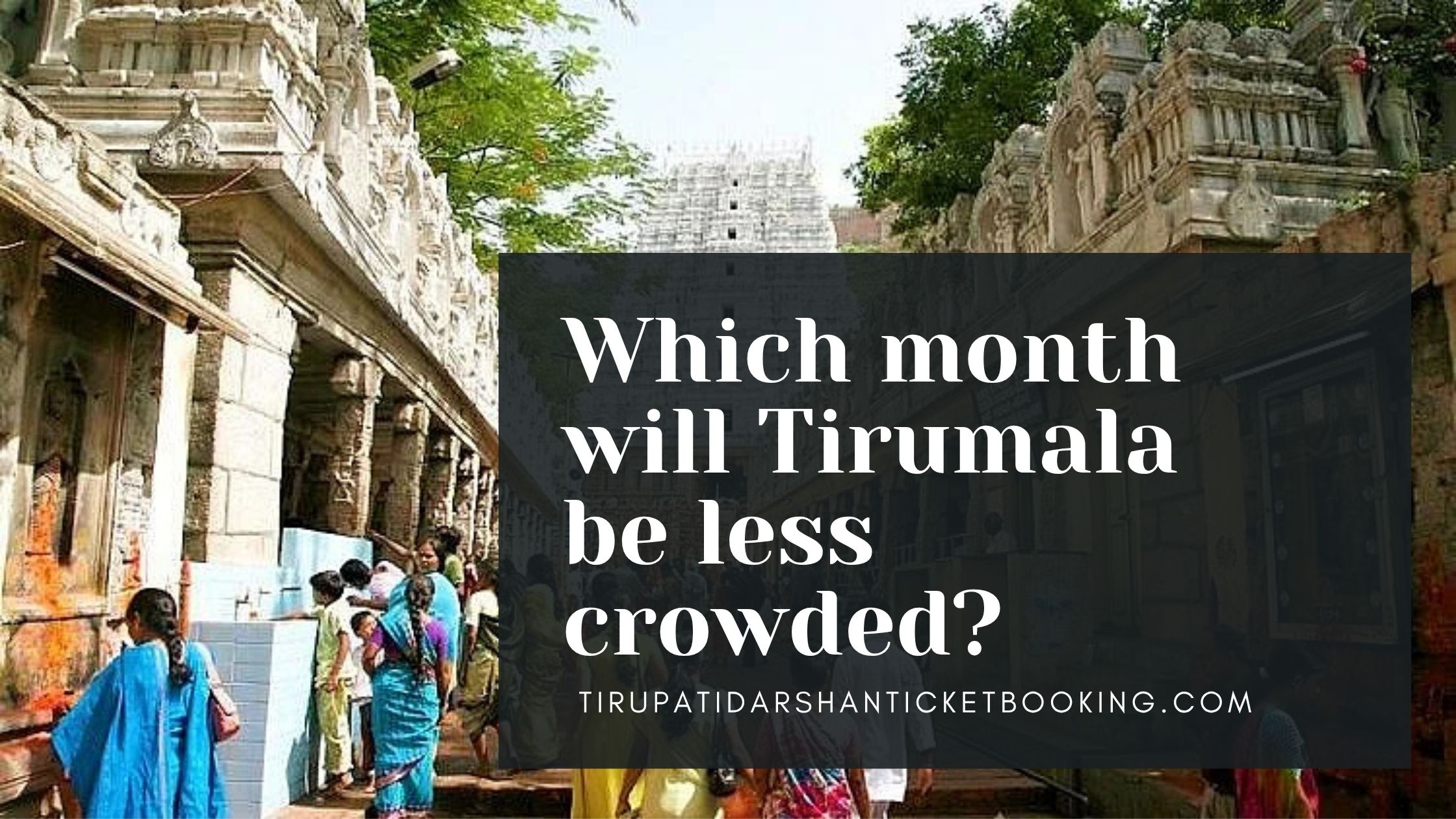
There is no single month that is universally less crowded, because the Tirumala crowd cycle is driven by three overlapping calendars: the school vacation calendar, the festival calendar, and the weather calendar. A month that is quiet for a family travelling from Chennai may be peak for a pilgrim coming from Karnataka, and a month that looks empty on the TTD data charts may be filled with festival-specific arrivals that the monthly average does not capture.
That said, the data does point to a clear answer. Based on TTD's 2025–26 footfall figures and the official festival calendar, the least crowded months are February, May, June, July, and November — with the important caveat that each of these months carries its own specific risk, and the "quiet" label only holds if you avoid the festival dates within them.
To understand how the monthly cycle relates to the daily cycle, you may find our guide on which day has less rush in Tirumala useful. The two calendars operate on different rhythms, and planning well requires understanding both. For real-time context before you book, our article on is Tirupati crowded today tracks current waiting times against the official figures, and our guide on is there rush in Tirumala tomorrow covers short-term conditions.
The Short Answer: Best Months at a Glance
| Month | Crowd Level | Notes |
|---|---|---|
| January | Very High | Vaikunta Ekadasi tail, peak season |
| February | Low | Post-January calm, transition month |
| March | Moderate | Ram Navami and Ugadi bring spikes |
| April | Moderate | Summer heat begins, holiday rush starts |
| May | Low to Moderate | Summer vacation rush offsets weather |
| June | Low | Record monthly footfall in 2026, but dispersed |
| July | Low | Monsoon, fewest festival dates |
| August | High | Janmashtami, Pavitrotsavam, Sravana Masam |
| September | Very High | Brahmotsavams |
| October | Very High | Navaratri Brahmotsavams |
| November | Low | Post-festival calm after Deepavali |
| December | Very High | Vaikunta Ekadasi, peak season |
The table is a starting point, not a conclusion. Each of the "low" months has a specific condition attached to it.
February: The Transition Month
February is the month that most experienced devotees recommend, and the reasoning is structural rather than anecdotal.
By February, the Vaikunta Ekadasi window has closed. The December–January peak season has ended. The next major festival is Ram Navami in March. The result is a two-to-three-week window in which the temple operates near its lower baseline — approximately 60,000 to 70,000 devotees per day on weekdays, compared to the 90,000+ figures seen in January.
The weather also cooperates. Temperatures in Tirupati and Tirumala sit between 18°C and 28°C, which is cool enough for comfortable walking and warm enough that the hilltop does not require heavy clothing.
To understand how these daily figures translate into waiting time, read our guide on how many people get darshan in Tirumala per day. That article breaks down the footfall bands and what each band means for the free Sarva Darshan queue.
The February Caveat
One point of confusion needs to be flagged. Some sources, including earlier articles on this site, list February as part of the "peak season" running from October to February. This is inaccurate as a blanket statement, and the discrepancy matters.
The peak season effectively runs October through January. February is the tail of that season, not its core. Daily averages in February are consistently lower than in December or January, and the festival calendar is emptier. The "peak season" label reflects the fact that February is still busier than May or July, not that it is as busy as December.
If you are planning a February visit, treat it as a low-crowd month with a residual tail of peak-season volume, not as a full peak-season month.
May, June, and July: The Summer Window
The summer months present a paradox. The school vacation period brings families to Tirumala in large numbers, yet the months also record some of the lowest per-day footfall figures of the year.
May
May sits at the start of the summer vacation rush. The hilltop stays a few degrees cooler than Tirupati, but the base temperature can exceed 40°C, which deters some pilgrims from travelling. Daily footfall averages around 80,000 to 84,000 during May, with the peak concentrated in the last two weeks when schools close.
June
June 2026 set a record for the highest monthly footfall in TTD history — more than 25 lakh devotees over 30 days, with a daily average of nearly 84,000. On paper, that looks like a busy month. In practice, the volume is spread across the entire month rather than concentrated into a festival spike, which means the daily waiting times are shorter than the monthly total suggests.
July
July is arguably the quietest month of the year for two reasons. First, the monsoon reduces the appeal of the pilgrimage for casual visitors. Second, the festival calendar is nearly empty. Janmashtami falls in August, and the Brahmotsavams do not begin until September. The result is a long stretch of unbroken low-crowd days.
The trade-off is weather. The ghat road can be slippery, and the footpaths are sometimes closed for short periods due to rain and wildlife movement. To understand the walking rules and safety protocols during monsoon, read our guide on is walking to Tirumala allowed now.
November: The Post-Festival Lull
November is the quietest month of the final quarter. The Deepavali festival has passed. The Navaratri Brahmotsavams have ended. The Vaikunta Ekadasi window does not open until late December. The result is a three-to-four-week stretch of reduced footfall that sits between two of the busiest periods of the year.
The weather is pleasant — cooler than October, warmer than December — and the temple operates near its baseline daily average of 73,000 devotees.
The main risk in November is the Karthika Masam period, which falls between mid-November and mid-December depending on the lunar calendar. Karthika is considered auspicious for temple visits, and footfall rises during this period. If you are planning a November visit, check the lunar calendar before booking.
The Months to Avoid
Six months carry structural crowd risks that no amount of planning can mitigate.
August
August is dominated by three overlapping events: Janmashtami (August 22) , Pavitrotsavam (August 23–25) , and Sravana Masam observances throughout the month. Sravana Masam brings 70,000 to 90,000 daily darshan figures, with Sarva Darshan waiting times of 18 to 24 hours. Janmashtami alone draws the year's largest non-Brahmotsavam crowd.
September and October
September and October are the twin Brahmotsavam months. The Salakatla Brahmotsavams run from September 15 to 23, and the Navaratri Brahmotsavams from October 12 to 20. During these periods, VIP Break Darshan is completely suspended, and special darshan categories for senior citizens, NRIs, and donors are also cancelled.
For a complete list of suspension dates and the rules that apply during these periods, read our coverage of TTD VIP Break Darshan new rules 2026. To check whether the premium darshan is operating on a specific date, our guide on is VIP break darshan available in Tirumala now provides the current status.
December and January
December and January are dominated by Vaikunta Ekadasi, which draws 200,000+ daily peak pilgrim density across the ten-day Vaikunta Dwaram window. Waiting times for free darshan routinely exceed 24 to 48 hours.
March
March is a moderate-crowd month, but it carries Ram Navami and Ugadi — both of which bring festival-specific spikes that can be as dense as a peak weekend. If your visit falls on either date, treat the month as high-crowd.
To understand which specific days within any month are worst, read our guide on which day is less crowded in Tirumala and our article on which day is less rush in Tirupati.
The Discrepancy Worth Noting
A practical point for anyone reading multiple sources on this question: the "peak season" label is applied inconsistently across travel blogs and even across some TTD communications. Some sources treat it as October to February, others as November to January, and still others collapse the entire period into a single "festival season" that runs from September to February.
The most defensible reading of the data is this. The core peak season runs October through January. February is a transition month with residual traffic. March through July is the low-crowd window, with July being the quietest month overall. August through September is dominated by festival events. November is a second low-crowd window squeezed between the Brahmotsavams and Vaikunta Ekadasi.
If you can travel in July, that is the single best month for avoiding crowds. If you cannot travel in July because of work or school commitments, February and November are the next best options.
How to Plan Around the Month
Match the Month to the Darshan Category
If you are planning to use the Srivani Trust VIP Break Darshan, you need a month in which the category is operational. That rules out September and October entirely, and it rules out Mondays year-round. To understand what the ticket delivers and what it costs, read our guide on what is the benefit of a ₹10,000 ticket in TTD and our article on how much does VIP Break Darshan cost at TTD.
If you are planning to use the ₹300 Special Entry Darshan, the month matters less because the ticket operates year-round. But the waiting time still varies by crowd level. To compare the two categories in cost and time, read our guide on what is the difference between VIP Darshan and Special Entry Darshan.
Book the Room and the Darshan Before You Book the Month
TTD accommodation releases on a monthly quota cycle that opens 60 to 90 days in advance. If your preferred month is February or November, the rooms sell out just as quickly as in peak months because supply is the same. To understand the release timings, read our guide on what are the TTD room booking timings.
For the practical strategies on securing a room, read our guide on how to get rooms easily in Tirumala. For the trade-offs between staying on the hill and at the foothills during a quiet month, our comparison of is it better to stay in Tirumala or Tirupati covers the cost and convenience factors.
Allow Two to Three Days Regardless of Month
Even in a quiet month, the temple requires time. Our guide on how many days are enough for Tirupati Darshan explains how to match stay duration to darshan category, but the short version is that a single-day pilgrimage is only realistic if you hold a confirmed Srivani Trust ticket and are arriving by air.
Summary: The Month-by-Month Verdict
| Priority | Recommendation |
|---|---|
| Absolute quietest | July |
| Best weather and low crowd | February |
| Second-best weather and low crowd | November |
| Summer window with manageable crowds | May, June |
| Avoid entirely | August, September, October, December, January |
| Approach with caution | March (Ram Navami, Ugadi), April (school holidays) |
Frequently Asked Questions
Which month is the least crowded in Tirumala?July is the single quietest month, primarily because the monsoon reduces casual travel and the festival calendar is nearly empty. February is the best combination of low crowd and pleasant weather.
Is February crowded in Tirumala? February is a transition month. The December–January peak has ended, but residual traffic remains. Daily footfall typically runs 60,000 to 70,000 on weekdays, well below December figures.
Is November less crowded than October? Yes. October is dominated by the Navaratri Brahmotsavams (October 12–20). November is the post-festival lull, with the only major observance being Karthika Masam, which varies by lunar calendar.
Can I visit Tirumala during the Brahmotsavams? Yes, but the experience is very different. VIP Break Darshan is completely suspended from September 15–23, and special darshan categories for senior citizens, NRIs, and donors are also cancelled. To understand what remains available, read our guide on is VIP break darshan available in Tirumala now.
Is June 2026 a good month despite the record footfall? June 2026 recorded more than 25 lakh devotees across 30 days, but the volume is dispersed rather than concentrated into festival spikes. The daily waiting times are shorter than the monthly total suggests.
Which months should I avoid if I want the VIP Break Darshan? Avoid September and October entirely, since the category is suspended during the twin Brahmotsavams. Avoid Mondays year-round. To understand the full suspension calendar, read our coverage of TTD VIP Break Darshan new rules 2026.
What is the best month if I can only travel during school holidays? May and June are the summer vacation months. Both carry higher footfall than July, but the crowds are dispersed across the month rather than concentrated into festival spikes. June is marginally better than May for daily averages.
Does the monthly crowd level affect the ₹300 Special Entry Darshan? Yes, but less than it affects the free Sarva Darshan. The ₹300 ticket operates year-round, and the wait time increases during peak periods from 2–4 hours to 4–6 hours.
Is there a ticket option for ₹700 or ₹1,000? The ₹700 ticket is the Pushpayagam Seva, which is a special ritual rather than a darshan category. The ₹1,000 figure is not a standard ticket price. To understand both, read our guide on what is a ₹700 ticket in Tirumala and our article on is a ₹1,000 ticket available in Tirumala.
Final Planning Notes
The quietest month on paper — July — is also the month with the highest risk of weather disruption. The best month overall, weighing crowd level, weather, and festival avoidance, is February. The second-best is November.
If you cannot travel in either, the summer window from mid-May through June is workable, provided you accept that the daily footfall will be higher than in February but not concentrated into a single festival peak.
To check the current status of the darshan categories and whether the temple is operating normally on your planned date, read our guide on what are the latest news on Tirumala Darshan. For the fastest route to a confirmed darshan slot regardless of month, read our article on what is the fastest way to book Tirumala Darshan tickets.
If you are planning without a prior booking, our guide on can I get same-day darshan at Tirumala and our article on can we go directly to Tirupati without booking set out what remains available on arrival.
And before you travel, review what is not allowed in Tirumala so that nothing at the temple entrance disrupts your visit regardless of the month you choose.